


Photos by Jennifer Martini
Every day, Monday through Friday, at 5 p.m., Brian Kinney gets into his car, pulls out of his parking spot at the law firm in Grandview, Ohio, where he works as a paralegal, and heads to the exit. There, he awaits oncoming traffic on Goodale Blvd., a curved road that will take him home. Once clear, he pulls out and drives past the tree that changed his life forever.
On an early fall day in September, 2009, Kinney was riding his motorcycle. This time, when he pulled onto Goodale, a car came barreling around the curve. “I couldn’t see the car coming because there were cars parked along the street,” he says. “I gunned the bike to try to get out of the way of the oncoming car but ran off the road, flew off the bike and hit a tree head on.”
Also this month:
The Process of Sexual Self-Discovery Sex, Women and SCI |
Wearing his helmet, Kinney didn’t damage his brain, but sustained a T1 injury. When his doctor told him he wouldn’t walk again, he couldn’t comprehend the permanence of his situation. “I’m wearing full gear, I’ve got my back and head protected,” he says. “I thought maybe I’d break an arm or leg. I didn’t break any other bone but my back, I didn’t have a scratch on me and there was minimal damage to my bike.”
The day after his injury in Ohio State University Hospital, he asked his dad — who’d raced up from Alabama to be with his son — to make a call to his best friend, Tiffany, whom he’d dated for three and a half years after meeting her at work.
Problem was, he had broken off their relationship two months prior.
Never Stop Loving
For most of July and August of 2009, after their breakup, Tiff spent her downtime at home staring at four walls, crying.

“We were doing great as a couple, even talked about having kids and marriage, when in June 2009 we started having trouble,” she explains. “At the time, Brian was 25 and I was 29, and I think, generally, women tend to mature more and are ready for things more than men.”
She admits that at her age, she was ready to start a family but Brian, having come from a family with a high divorce rate, had a fear of marriage. “My parents are both twice divorced,” he says. “My uncle and aunt were both twice divorced, my sister, my cousins, all my extended family have been divorced. I was 6 when I vividly remember watching Dad pack up all his stuff. So I was scared shitless when we talked about settling down, starting a family.”
He adds that Tiff had once told him she wanted to have kids by the time she was 30.
“Her 30th was approaching and I told her I wasn’t ready and couldn’t do it anymore,” he says. “I knew I cared about her, but I just needed to get out, it was getting way too intense for me, and I felt like I was leading her on.”
“He was looking at it from both a selfish and a selfless standpoint,” Tiff says. “He wanted to experience more, yet he didn’t want to hold me back.”
Tiff moved out of Brian’s house in June 2009.
“I did everything to keep her off my mind,” he remembers. “I went out with friends all the time. I flirted with other girls but found I didn’t care about them, at least not as much as I did her.”

During July and August they’d get back together to hang out. Brian says it felt like he had his arm back. “But I didn’t want to back out of my decision,” he says. “I’d feel like I was being weak.”
About a week before Brian’s accident, Tiff told him in an email that if they were really over, then she couldn’t talk to him anymore. “It was a battle for him, there wasn’t anything malicious behind it,” she adds. “But I was heartbroken, my whole world turned upside down because I never stopped loving him.”
On September 10, a friend of Tiff’s talked her into going to the Ohio State University’s football game, to do some tailgating and have some fun in downtown Columbus. “I just wasn’t in the frame of mind and wasn’t going to go,” she says. “But I went and was having a good time when my phone rang.”
It was Brian’s dad. He told her that Brian was in a motorcycle accident the night before and was in the ICU at Ohio State University Hospital and had requested she be called.
“It was a brief conversation and I panicked,” Tiff says. “The only thing I asked was if Brian was conscious.” He was, and Tiff felt a little relief that he wasn’t in a coma. She quickly made her way out into the crowd of tailgating revelers and hailed a cab. “I’m never in that area of town, ever,” Tiff says. “It’s ironic and it sounds cheesy, but I was meant to be there that day.”
Just blocks away, Tiff quickly made it to the hospital and into ICU. “I’ll never forget the look on his face. He was scared but also relieved to see me,” she says. “With panic and fear in his eyes, he told me he couldn’t feel anything from his sternum down.”
She didn’t know how to react, what to think.
“Regardless of the situation of our relationship, he needed me to be there and I didn’t want to be anywhere else,” she adds. Even so, she rode a roller coaster of “should I stay or should I go,” while Brian battled his own inner demons.
One beautiful sunny day, while sitting outside in the hospital patio, Brian heard the rumble of a motorcycle drive by. “I thought, ‘that could be me right now,’” he remembers. “Then I saw a city bus drive by and for a split second, I wondered what would happen if I rolled out in front of that bus.”
Rehab Reconnect
It was one month from the day of Brian’s injury to the day he went home.
Once home in a rented condo, his stepmom helped him during the day, and Tiff helped out at night. One day while alone with a full body brace on, Brian found himself unable to move or sit up after taking a nap.
“I’d gotten used to the hospital bed and with the brace on, I couldn’t get up,” Brian says. “That’s when it hit me that it was never going to be the same. I just cried my eyes out, it was a horrible feeling.”
Then waves of depression came.
“At the hospital, you’re staying busy,” he says. “To go home and not do anything, that’s when your gears start turning. You think about how bad your situation is, how you’re going to live like this and how is anybody going to love you.”

Nonetheless, Brian and Tiff resumed their intimate relationship and Tiff soon moved into the condo. “I quickly realized that I had thrown away something great,” Brian says. “Having someone who loves you unconditionally and will stay when you can’t control your bladder or you’re pooping in your pants … I couldn’t believe the love that she had for me. I knew I loved her, yet my heart and my head were still fighting.”
“About a week or so after he got home from rehab and settled in, I had a second to think about our situation and what I was doing there,” Tiff says. “I started to question a lot of things, and the million dollar question in my head, was: ‘If this accident hadn’t happened, would I be here?’”
Did Brian just want her there to help? Inch by inch, Tiff’s anger began to surface.
“I battled with if I wanted to take this on and sacrifice the way of life I envisioned for myself, and to be that person for him,” she says. “Anybody would question that, but it was more about his intentions. I didn’t want to be there just for convenience.”
No matter how much Brian tried to reassure Tiff, underlying doubt remained. Does he really love me, she would wonder. Was he saying it because he truly, truly loved her or was he saying he did because he needed her and was afraid to be alone?
It was a constant battle for her: She knew she couldn’t just leave but needed reassurance of his love.
New Beginnings
Weeks became months, and Brian was back working full-time at his paralegal job. The company modified their entry doors and supplied him with a desk that will raise up so he can work while using his standing wheelchair. And he built a fully accessible home that he moved into in 2010.
“Things were still up in the air for me,” Tiff says. “I questioned whether I should move in, yet I didn’t want to leave and he didn’t want me to go.” Something told her to stay and give it time, so she decided to move in and see how things played out.
“Things turned around slowly,” she says. “There was an elephant in the room that caused tension. But coping and adjusting to this house brought us closer together, and I started to look at him in a different light.” She gained even more respect and admiration for him watching how he was dealing and coping with his new way of life.
“I was completely in awe of his attitude,” she says. “It made me love him more deeply and on a different level, and I realized this was where I was meant to be, where I belonged.”
Time moved on, tensions eased while the couple enjoyed their new house.

Brian designed and built accessible features in his home, and while puttering in his garage next to his motorcycle, he decided to modify it so he could ride again.
“I felt uneasy every time I got on the bike,” he says. “I had to worry about getting the legs down at a stop and I tipped it over a couple times, which is a horrible feeling. Plus, every time I’d go for a ride, Tiff would be a nervous wreck. I felt horrible every time I’d leave.
“I’m glad I did it and overcame it,” he adds. “But, it’s not a good idea
[for a para] to get on a two-wheeled motorcycle in city traffic.” [See Motorvation, January 2015, for adapted motorcycle riding options.]Brian’s feelings for Tiff continued to blossom, and they grew stronger and closer when one day, he woke up next to her, looked at her and realized how happy he was and how selfish he was being. He decided to sell his motorcycle to secretly buy the love of his life an engagement ring. With Tiff’s family, with whom he is extremely close, Brian planned a camping trip to Michigan, where he would propose.
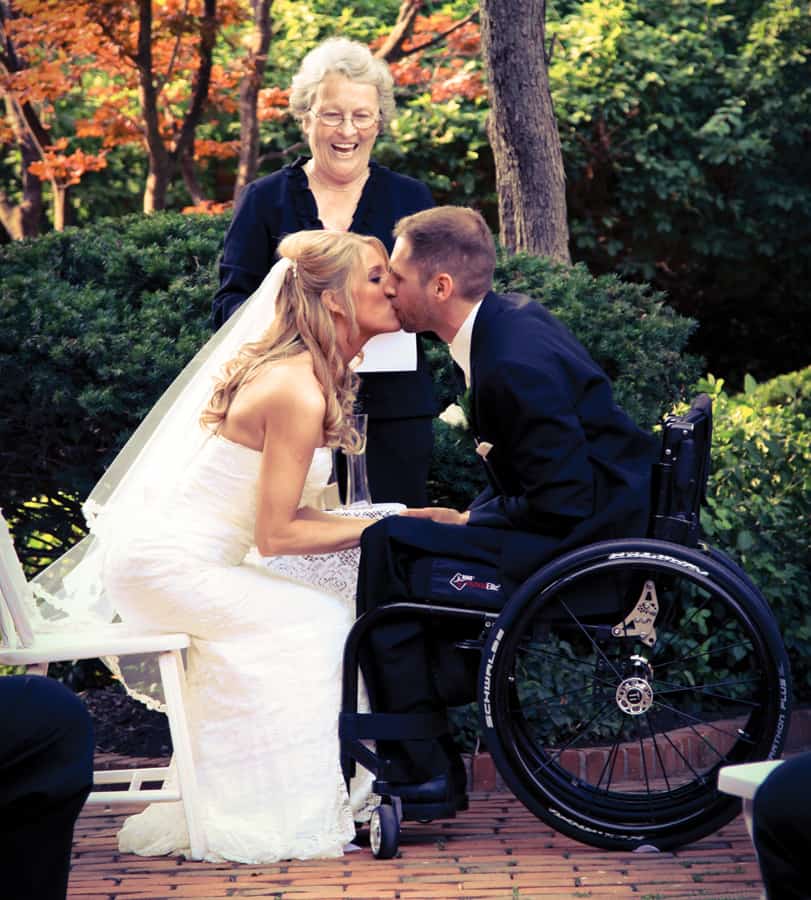
 On July 12, 2012, Tiff’s dad, Harold Estep, filmed Tiff taking a picture of her sister Brandi and her family standing by Lake Michigan. The camera takes in the whole scene as Brandi and family unzip their jackets to reveal T-shirts that read sequentially, “Tiff Will You Marry Me?” The proposal and resulting video is posted on Brian’s YouTube vlog channel, Paralyzed Living. It is a delightful tear jerker as the camera catches Tiff’s bewilderment and her mom’s unfettered joy. Tiff said yes and they were married in June 2013.
Wanting a Family
In January 2014, they began in vitro fertilization to start a family. But, getting pregnant has proved to be another hurdle to overcome.
“I can’t ejaculate and had tried several ‘remedies,’ including a Ferticare vibrator and a Baclofen pump, but nothing worked for me,” Brian says. “With IVF, they retrieved my sperm through biopsy, but the quality of [bioptic] sperm after freezing and thawing is not great. Our $15,000 IVF failed to produce an embryo. More than the money, it was a huge letdown for us.”
In November 2014, Brian received an email from Brad Stubblefield, a Paralyzed Living viewer who had watched Brian’s vlog about attempting IVF. “Brad had reached out to me earlier, in 2012, after viewing my vlog on modifying my motorcycle,” Brian explains. “He kept my email and contacted me again, telling me he and his wife were in the exact situation as we were.”
Stubblefield and his wife had gone through two unsuccessful rounds of IVF, when he found out about a way that helps ejaculation. He told Brian about using a TENs unit, which is normally used to settle nerve-related pain by way of four wires with pads that attach to your skin, but also works for stimulating ejaculation. Brian now uses a related device, an electrical muscle stimulator. For the purpose of ejaculation, electrode pads are attached to the base of the penis. Using this method, men who have an SCI can get fresher and higher-quality sperm, which couples can use with intrauterine insemination.
Brian bought an EMS online for $35 and it worked the first time he used it. “It was the first time I’d gotten to that point since my injury, and it was amazing, I just felt more complete!” he says.
“The EMS unit is a game changer,” Tiff says. “We were devastated over the IVF, and the $15,000. With the EMS, it will cost $1,000 per IUI cycle, but now we can try home insemination for free!”
 However, after his first try with the EMS, Brian became dysreflexic and his blood pressure went haywire [due to his T1 injury level]. “It’s so much stimulation that my BP went through the roof,” says Brian. “I had the worse pulsating headache, each time my heart would beat and even after I turned the unit off, it took an hour for the pulsating to stop. We were so disappointed, not to mention that I don’t want to have a stroke.”
But the couple wasn’t daunted. To combat autonomic dysreflexia, Brian’s doctor prescribed Nifedipine. Taken one hour before using the EMS, Brian now successfully ejaculates without AD, but cautions to take the drug on an empty stomach as it can trigger AD otherwise.
“I’ve done a lot of research since I got the unit,” Brian says. “There is a 26-page thread on an SCI website (CareCure) where everybody who uses these units explains how it has worked for them and how they attach the pads. I’m not aware of anybody who had as severe AD as I had.”
Looking Forward
Since his accident, Brian has learned what unconditional love means, he and Tiff have renewed hope for a future pregnancy, and the city has painted “no parking” stripes along Goodale Blvd., outside of Brian’s law firm parking lot. The tree that Brian hit has grown, and the chunk he took out with his head has closed up to a small knot.
“Some days it’s hard to drive by the tree,” Brian says. “Especially in September if the sun is setting just right and the temperature is the same. But seeing that knot is like watching an old wound heal, and each year it gets a little easier.”
Resource
Brian Kinney has a new video out on YouTube describing different methods he has tried for getting viable sperm titled: “Ejaculation After a Spinal Cord Injury.” http://youtu.be/fiN2_3lYrE
Relationships: How Long do They Last?
NM ran a survey in early January to find out about relationships — how long they last, whether disability is a factor when couples split up, and when this is most likely to happen. Following are selected preliminary results from the survey. A more complete report on this survey, along with comments by survey participants, will run in a future issue of NEW MOBILITY.
| Percent in a relationship at time of onset of injury or disability: 60% |
| Percent who split up after injury or onset of disability: 33% |
| Percent of split-ups within first 5 years after injury or onset: 72% |
| Percent of couples who did not split up after injury or onset: 67% |
| Percent of those couples together for up to 1 year: 11% |
| Percent of those couples together for 1-10 years: 29% |
| Percent of those couples together for 11-20 years: 31% |
| Percent of those couples together for 21-30+ years: 29% |
Support New MobilityWait! Before you wander off to other parts of the internet, please consider supporting New Mobility. For more than three decades, New Mobility has published groundbreaking content for active wheelchair users. We share practical advice from wheelchair users across the country, review life-changing technology and demand equity in healthcare, travel and all facets of life. But none of this is cheap, easy or profitable. Your support helps us give wheelchair users the resources to build a fulfilling life. |


I am married, and I have cerebral palsy!
What is important in marriage is having
things in common!