


Editor: This is the seventh in an eight-part series of “My Town” personal essays by New Mobility readers and freelancers.
Out on the prairie where I live, “town” is not a place you go everyday. In fact, with the price of gas passing $4 and our Ford dually getting about 4 miles per gallon, any trip to town has to count for something.
Our land was claimed in the Oklahoma land run of 1889. The original deed was signed with an “X” back when Benjamin Harrison was president and Oklahoma was still Indian territory. My husband and I are the third owners. Our 160 acres is covered in native grasses and red dirt that coughs up black rocks. Today it’s bounded on two sides by paved highways, but many a cowboy still wears pink socks inside his boots thanks to the insidious red dirt that laughs at Clorox.
A cavalcade of coyotes, bobcat, wild turkeys and does with speckled fawns pass by our windows unperturbed by the horses, cattle, buffalo and dog (Rhodesian ridgeback) we’ve added. Scorpions, tarantulas, ticks, rattlers, copperheads and armadillos are the underworld of our world. But Mother Nature polices the place with the lethal force of wildfires, tornadoes, ice storms and drought — all wrapped in the Oklahoma wind.
You can’t live in Oklahoma without being a connoisseur of wind. There are the fetid, hot-breath-of-a-panting-dog winds of summer and dust-laden gales that sent the Okies to California — a la Steinbeck’s Grapes of Wrath. In January comes the fire-breathing “wind on crack” that blackens acres of the prairie in the blink of an eye or the throat-searing frozen vodka blast that crunches icy power lines and tree limbs like cocktail pretzels. I returned to Oklahoma for the winds of Rodgers and Hammerstein that “come sweeping down the plains” and tousle wheat fields into synchronized chorus lines.
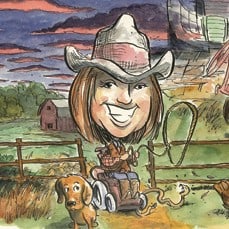
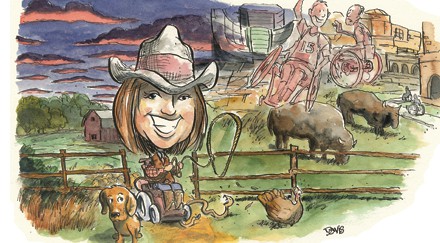
Living on the prairie requires a ready Plan B. I have an outdoor propane grill and an indoor propane burner for heating bath water and food when tornadoes take out the power. I added a propane fireplace after 11 days without heat and power following an ice storm. There are candles and flashlights in every room and a supply of drinking water in the pantry. The gravel drive is a long half-mile to the highway, and I planned rolling into the water garden as a last stand against the range fires that can sweep in with lightening speed. But my husband insists I can make it out in my ramp van if I don’t slow down for the cattle-guards and stay on the gravel. As for other threats: Call the ranch manager when a rabid raccoon chases the dog. You can pen loose cattle with a Permobil “electric horse,” but you have to use the van if the buffalo get out — they snort at power chairs. It takes both practice and luck to run down tarantulas and scorpions in a wheelchair, so I use a cowboy boot on my fist while perfecting the technique.
No IMAX movie can compete with the panorama outside my window, where hawks ride the thermals over the pasture. Sunrises and sunsets explode east to west in shards of purple and orange. Clouds — dazzling white — dance on the lake’s mirror surface on cool mornings, and clouds murderously black throw lightening bolts on muggy nights, illuminating fractured scenes, like the birth of a new foal typically determined to arrive in a storm.
My mail arrives with an Orlando, Okla., address. I’ve never been there. In fact, the Orlando Volunteer Fire Department sent me a postcard saying our side of the highway is no longer in their district. I have a polygamous relationship with a number of other nearby communities. We might have dinner at Lucille’s in Mulhall, a tiny town all but destroyed by tornadoes in 2001. The bank that was established in the land run was the only building that survived.
We buy feed in Perry, the little town with the courthouse square where Timothy McVeigh was caught and jailed after he blew up the Murrah Federal Building in Oklahoma City.
I came home to Oklahoma nearly 20 years ago to work in Stillwater at Oklahoma State University. The move capped two decades as a “glitter gypsy” in TV news, with stops in Buffalo, Columbus, Philly, Baltimore and Charlotte. Demographics Daily calls Stillwater a “dream town,” ranking it sixth of 634 small cities for quality of life, affordability, good jobs, good schools, good health care and small town character. It’s the kind of place where the community band plays on the library lawn every Thursday in the summer and families gather at Boomer Lake for fireworks on the Fourth of July. University professors work with Boy Scouts and serve on city boards between developing body armor for soldiers in Iraq and turning a weed called switch grass into biofuel so corn-based ethanol isn’t driving up the price of feed and food.
OSU students are the best and brightest from Oklahoma, surrounding states and 120 countries. During The Big Event, a day of community service each spring, three or four student volunteers come out to the ranch and clean out flower beds or the water garden. I’ll never forget a focus group organized for a communications consultant from California where a typical student said his goal was to graduate and earn as much money as possible as fast as possible so he could get home before his dad lost the family farm. In 2000, when my Ford Explorer tumbled off the highway in a driving rainstorm, a stormchaser dialed 911 and a carload of OSU students returning from a fieldtrip held a tarp over me until the ambulance arrived. I returned to campus two months later on wheels.
Thanks to a loyal OSU alumnus named Boone Pickens and a recent statewide bond issue, $900 million worth of construction is underway on campus now. Boone Pickens Stadium will hold 60,000 when it’s complete next year, and recently-renovated Gallagher-Iba Arena is considered one of the rowdiest in college basketball. Tickets are hard to come by, but accessible seating is great. Every spring, Disability Awareness Week on campus features a Basketball Bash pitting the road warriors of the wheelchair basketball team against the NCAA athletes. As one who cannot get back in my chair unassisted, the rough-and-tumble spectacle is the stuff of nightmares, but it certainly erases any stigma of helplessness surrounding those of us who use chairs for mobility.
The University brings a diverse array of speakers, entertainers and artists to Stillwater — also listed as one of America’s 100 safest cities. As in most college towns, pizza is cheap but unforgettable at a local hangout called The Hideaway. Expect a higher tab at The Rancher’s Club — a collaboration of the University Meats Lab and the School of Hotel and Restaurant administration spiffed up with donations from successful alumni. The steaks are mouthwatering, surrounded by original oil paintings of the sponsoring ranches. The T-shirts from Eskimo Joe’s (specialty: cheese fries) are seen around the world.
Surprisingly for a small town in a rural area, Stillwater boasts a local transit system — and every bus is accessible. Unfortunately, not every bus stop is … yet. A construction drive is underway. The campus is generally accessible and the City has spent millions in the past few years on sidewalk infrastructure and ADA compliance. Still, my big beef is getting parking tickets for backing into spaces in order to gain access on the side of my van where the ramp deploys.
Other days I worry that my tolerance level is too high. Out on the ranch, curb cuts aren’t a big issue (no curbs — and accessible cattle-guards are an oxymoron). The Justice Department is no match for armadillos who turn a pasture or yard from accessible to not overnight. It’s something to ponder as I pinch a sprig of mint from the herb garden and peruse The New York Times online.
Pioneer Long Distance Internet is the ISP that allows me to develop releases, brochures and websites for non-profits from United Way to a therapeutic riding center without leaving the prairie. E-mail and spam find me fine. The latest bestsellers arrive wirelessly on my Amazon Kindle. FedEx brings eBay purchases cheaper than Wal-Mart, and a satellite delivers more news and movies than I can watch.
I holster a cell phone instead of a six-shooter, but I’m very much at home on the range.
Natalea Watkins has been freelancing and patrolling the prairie on 24-inch wheels since sustaining a T5 SCI eight years ago.
Support New MobilityWait! Before you wander off to other parts of the internet, please consider supporting New Mobility. For more than three decades, New Mobility has published groundbreaking content for active wheelchair users. We share practical advice from wheelchair users across the country, review life-changing technology and demand equity in healthcare, travel and all facets of life. But none of this is cheap, easy or profitable. Your support helps us give wheelchair users the resources to build a fulfilling life. |


Recent Comments
Dick Crumb on Adapting Recreation To An Aging Body
Karen on The Everlasting Saratoga Cycle
Ted Kilroy on Handcycle Gear Guide